Research brief · November 2026
IMO Net-Zero Framework: the December showdown
MEPC 85 (30 Nov–3 Dec) and the resumed vote on 4 December will decide whether shipping gets a global carbon price, or a patchwork of regional rules.
Use the arrow keys to move through the deck once it has focus.
Read it as text
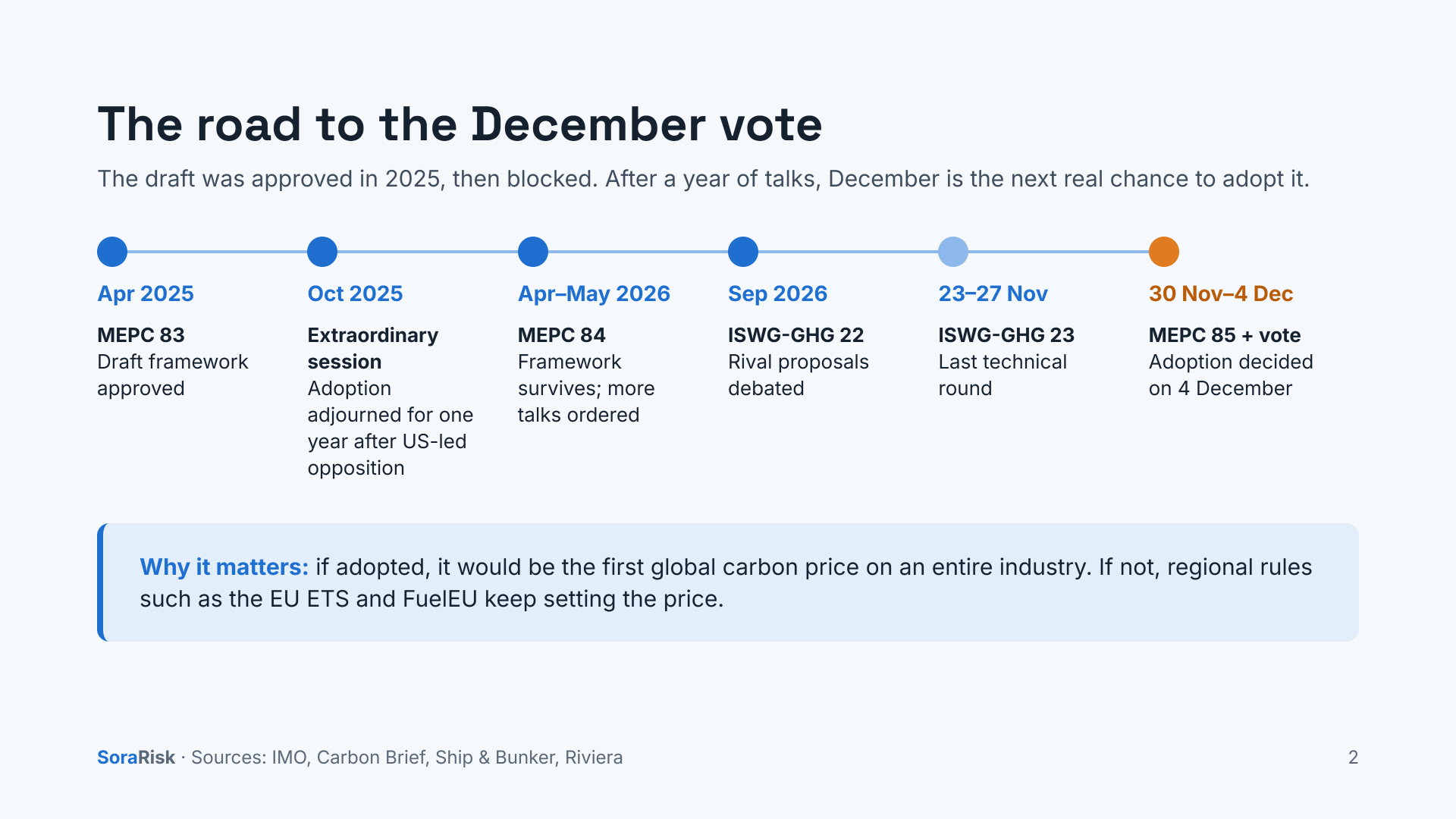
The road to the December vote
The draft was approved in 2025, then blocked. After a year of talks, December is the next real chance to adopt it.
April 2025 · MEPC 83: draft framework approved.
October 2025 · Extraordinary session: adoption adjourned for one year after US-led opposition.
April–May 2026 · MEPC 84: framework survives; more talks ordered.
September 2026 · ISWG-GHG 22: rival proposals debated.
23–27 November · ISWG-GHG 23: last technical round.
30 November–4 December · MEPC 85: adoption decided on 4 December.
Sources IMO, Carbon Brief, Ship & Bunker, Riviera
How the draft framework works
Two pillars: a fuel standard that tightens every year, and a price on the gap for ships that miss it.
Above the base target — $380
Pay Tier 2 units at $380/t CO₂e, or buy surplus units.
Between the two targets — $100
Pay Tier 1 units at $100/t CO₂e.
Below direct compliance — surplus units
Earn surplus units to sell or bank.
Higher fuel GHG intensity means higher cost. Prices are fixed for 2028–2030.
1. Fuel standard
Base target: −4% in 2028 to −30% in 2035. Direct compliance: −17% to −43% (vs 2008).
2. Price and IMO fund
Payments go to an IMO Net-Zero Fund, estimated at about $10bn a year.
Sources BIMCO, Sidley, Blank Rome (draft approved at MEPC 83)
Where most states agree
Most delegations accept the destination; the fight is over the mechanics. The US and some oil producers still oppose the framework outright.
A global fuel standard
Ships cut the GHG intensity of their fuel step by step, under one global rule.
A just transition
Part of the revenue should help small island and least developed states.
The same destination
Net zero by around 2050, with checkpoints in 2030 and 2040 (IMO 2023 Strategy).
Sources IMO 2023 GHG Strategy, Carbon Brief, Seatrade Maritime
The core fight: who controls the money
The approved text sends payments to a central IMO fund. Rival proposals would replace it with markets or direct payments.
Keep the approved framework
Who: the EU, Pacific and Caribbean island states, climate NGOs. Payments go into the IMO Net-Zero Fund, which rewards zero-emission fuels and supports vulnerable states; Tuvalu wants the $100 tier raised to $300. Why: predictable climate finance and a strong price signal for e-fuels.
Replace or soften the pricing
Who: Japan, Liberia (backed by several Gulf states), the US. Japan wants surplus-unit trading and direct payments to approved projects, with softer targets from 2030; Liberia wants surplus units only, starting at −6% in 2029; the US opposes any IMO fund. Why: avoid a global carbon tax, keep control of capital, limit freight costs.
Sources ENGINE, Ship & Bunker, Opportunity Green, Argus
What December means for shipping
Three plausible outcomes, each with a different cost path for owners, charterers and lenders.
Adopted as approved
A global price from 2028: $100 and $380 per t CO₂e on fuel-intensity gaps.
Adopted with changes
Softer targets or surplus-unit markets. Lower early costs, but market-set prices.
Delayed again
No global price. EU ETS and FuelEU stay the binding cost; other regions may follow.
Sources IMO, BIMCO, Thommessen, Carbon Brief