Research brief · November 2026
FuelEU Maritime: compliance on paper, transition on hold
Why the early compliance cycles did not shift fuel, and the reforms that could.
Use the arrow keys to move through the deck once it has focus.
Read it as text
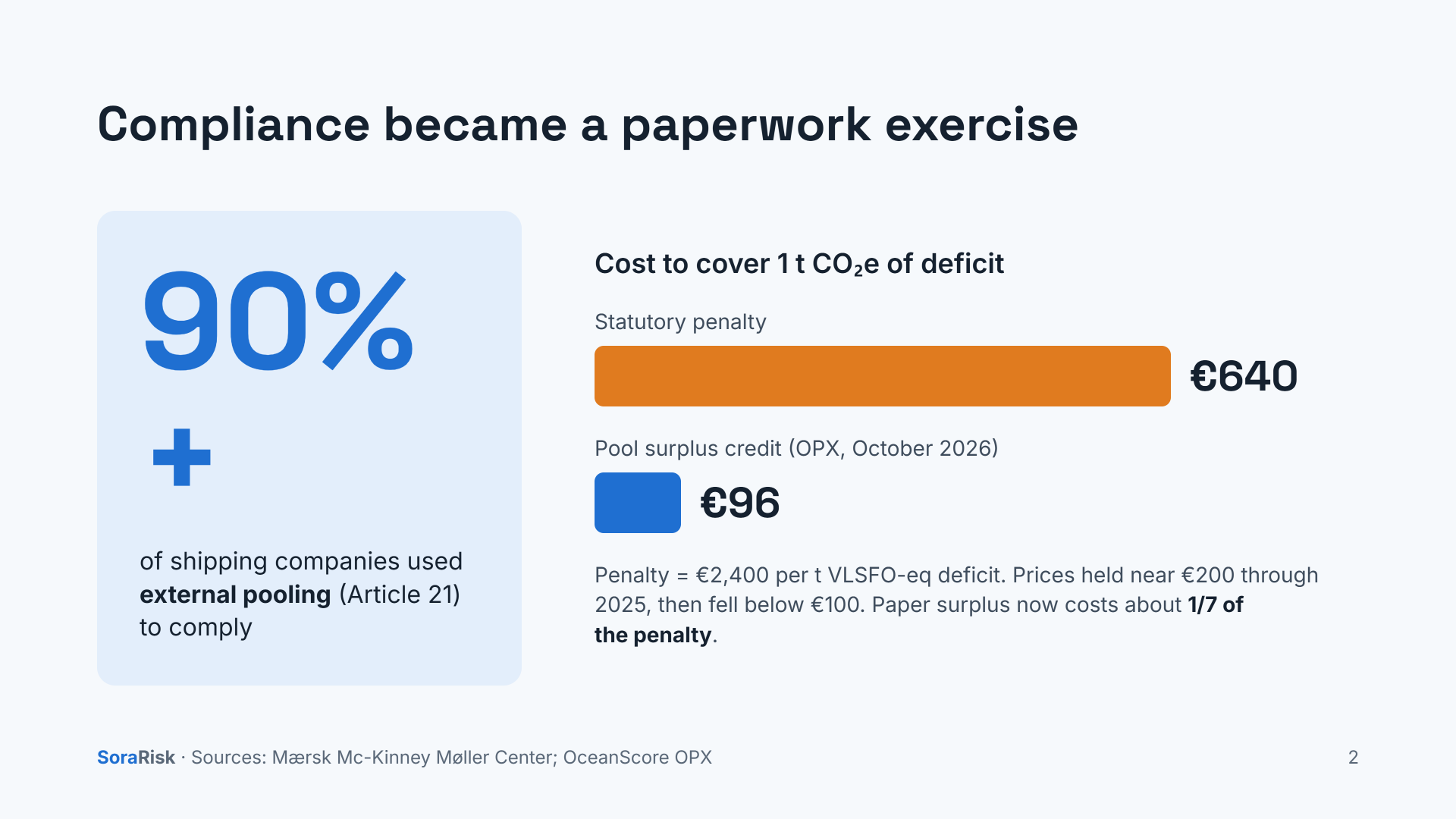
Compliance became a paperwork exercise
90%+
of shipping companies used external pooling (Article 21) to comply
Sources Mærsk Mc-Kinney Møller Center; OceanScore OPX
Existing assets captured the pool
Fossil LNG
Beats the 2020 baseline by design. Its cheap surplus was sold to oil-fuelled fleets.
Drop-in biodiesels
FAME B24/B30 blends need no engine or bunkering changes, so no CapEx.
E-fuels: under 5%
At 3–4× fossil cost, e-methanol, hydrogen and wind together made up <5% of early compliance.
Sources MMMCZCS, Lloyd's Register, Splash247
Fix 1–2: restrict pooling, ring-fence e-fuels
To prevent the regulation from becoming a permanent greenwashing mechanism, structural adjustments are being heavily negotiated.
External pooling cap
Cap the share of a vessel's deficit a third-party pool can cover (e.g. 45–50%). The rest must be cut on board.
LNG: internal use only
Fossil LNG surplus counts within the owner's own fleet, but cannot be sold on the open market.
RFNBO sub-quota
A strict, non-poolable 1–2% e-fuel share gives producers bankable demand to build plants.
Sources Reform proposals discussed around the Commission review
Fix 3: the 2030 cliff tightens supply
FuelEU targets tighten automatically. Even if reforms stall, the jump from −2% to −6% in 2030 shrinks the cheap surplus that keeps pooling prices low today.
−2%
−6%
−14.5%
2025–29
2030
2035
2020 baseline: 91.16 gCO₂e/MJ
What changes from 2030
Less surplus: fossil LNG beats the target by a much smaller margin.
Pricier pooling: scarce surplus pushes prices toward the penalty.
E-fuels gain ground: long-term e-fuel contracts become easier to justify.
Sources Regulation (EU) 2023/1805, Art. 4
Fix 4: make the decision-maker pay
FuelEU bills the ship's ISM company, usually the owner. But under a time charter, the charterer chooses the fuel. Moving the cost to the charterer puts the price signal where fuel decisions are made.
Charterer decides
Chooses speed, route and fuel, so it drives emissions.
BIMCO FuelEU clause
The contract shifts FuelEU costs to the charterer.
Charterer pays
For pool credits or biofuel bunkers: the polluter pays.
Sources OceanScore & Gard, European Commission, MMMCZCS, LR