Research brief · November 2026
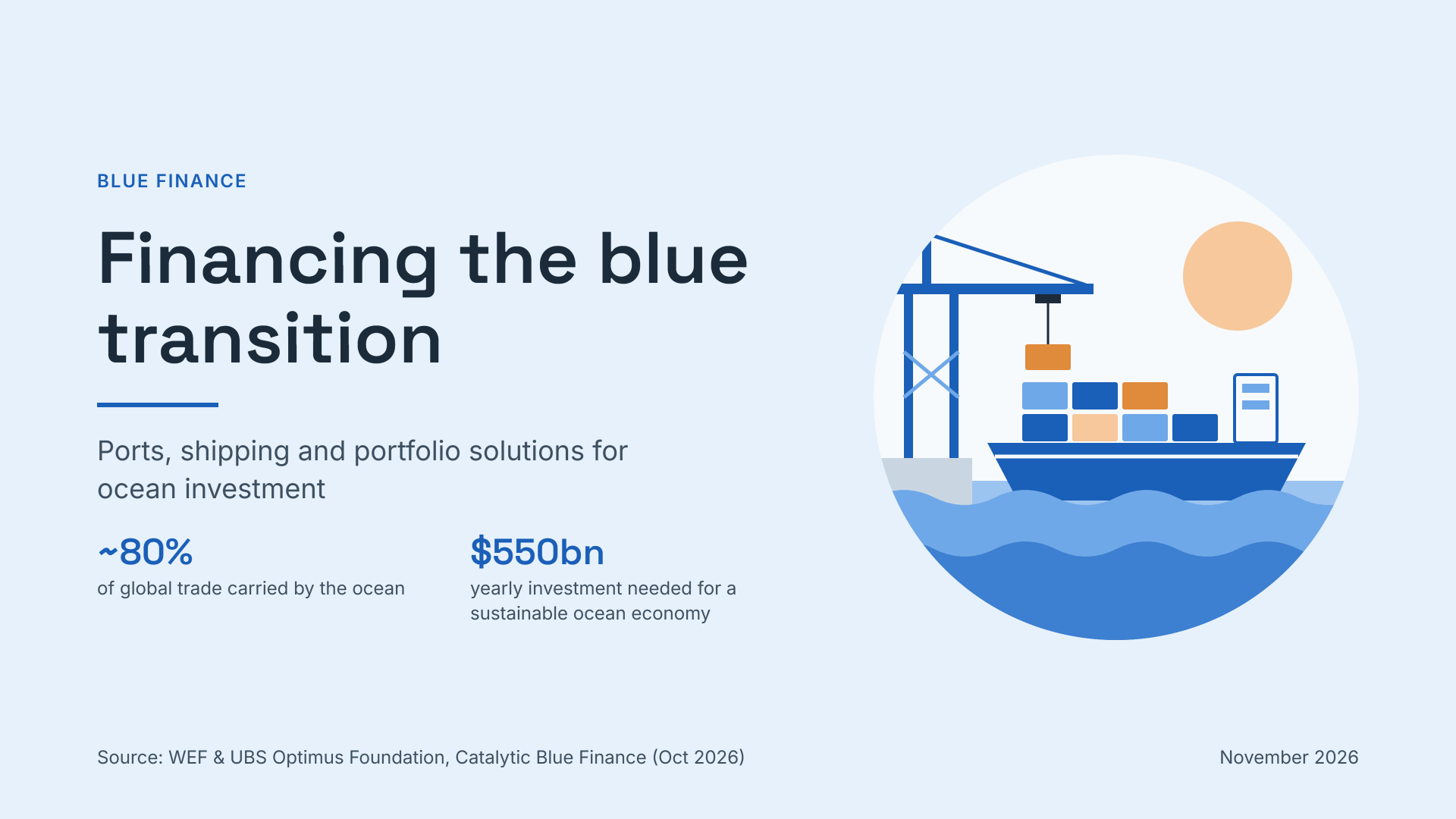
Financing the blue transition
Ports, shipping and portfolio solutions for ocean investment.
Use the arrow keys to move through the deck once it has focus.
Read it as text
The starting point
~80%
of global trade is carried by the ocean
$550bn
of yearly investment needed for a sustainable ocean economy
Sources WEF & UBS Optimus Foundation, Catalytic Blue Finance (Oct 2026)
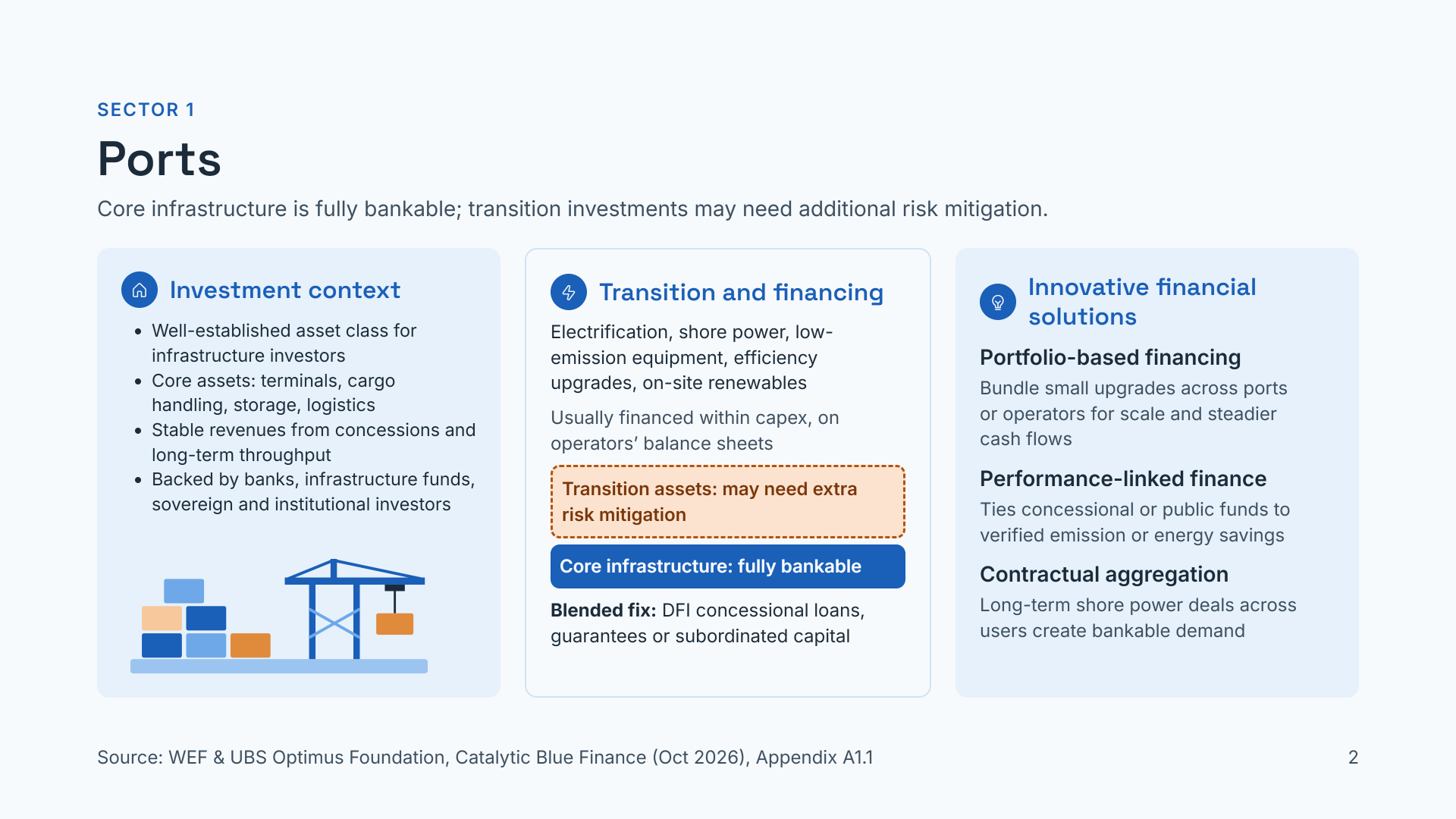
Sector 1: ports
Core infrastructure is fully bankable; transition investments may need additional risk mitigation.
Investment context
A well-established asset class for infrastructure investors. Core assets are terminals, cargo handling, storage and logistics, with stable revenues from concessions and long-term throughput, backed by banks, infrastructure funds, sovereign and institutional investors.
Transition and financing
Electrification, shore power, low-emission equipment, efficiency upgrades and on-site renewables, usually financed within capex on operators’ balance sheets. Core infrastructure is fully bankable; transition assets may need extra risk mitigation. Blended fix: DFI concessional loans, guarantees or subordinated capital.
Innovative financial solutions
Portfolio-based financing bundles small upgrades across ports or operators for scale and steadier cash flows. Performance-linked finance ties concessional or public funds to verified emission or energy savings. Contractual aggregation turns long-term shore power deals across users into bankable demand.
Sources WEF & UBS Optimus Foundation, Catalytic Blue Finance (Oct 2026), Appendix A1.1
Sector 2: shipping
The vessel often stays bankable; the transition increment needs complex structuring.
Investment context
Well-established structures for conventional vessels, with clear charters, residual value and operating track records. Lenders are banks, export credit agencies, leasing firms and private equity. The asset is asset-backed and central to global trade.
Transition and financing
Low-carbon vessels and retrofits — dual-fuel ships, engine upgrades, infrastructure interfaces — carry higher costs and technology and fuel supply risks that deter lenders. The base vessel takes conventional debt or leasing; the increment needs catalytic guarantees or concessional tranches. Long-term charters and cargo-owner commitments also help.
Innovative financial solutions
Green charter aggregation: cargo owners jointly commit to low-carbon capacity for steadier revenue. Fuel transition hedging manages future fuel cost and availability, possibly with public backing. Transition vehicles are dedicated platforms that finance and upgrade fleets, drawing institutional capital.
Sources WEF & UBS Optimus Foundation, Catalytic Blue Finance (Oct 2026), Appendix A1.2
Portfolio solutions for ocean investment
Ocean deals need specialist knowledge and are often too small; specialist managers concentrate that expertise and offer diversified exposure.
Investors pool capital
One entry point instead of separate origination, due diligence and monitoring.
Specialist manager
Sets the thesis, the criteria and the monitoring.
Diversified ocean portfolio
Exposure across deals rather than a single asset.
Risk allocation
Diversification reduces single-asset exposure but does not remove specific risks: asset, credit and transition risk stay specific, as in shipping. Catalytic capital can anchor a first fund or absorb defined risks, which helps less mature segments build track records.
Scaling potential
Opens themes too specialised or fragmented for institutions. Specialist managers hold the sector expertise, so each investor does not have to build it, and successive funds build track records, pipelines and evidence.
Sources WEF & UBS Optimus Foundation, Catalytic Blue Finance (Oct 2026), Section 4.1
What it takes to scale: replication conditions
Investable pipeline: enough investable deals within a clearly defined strategy.
A clear thesis: asset class, sector, maturity or objective — broad “ocean economy” exposure is not enough — run by managers with financial, technical and ocean expertise.
Credible measurement: sustainability criteria and outcome measurement: show measurable environmental or transition outcomes, and manage adverse impacts.
Sources WEF & UBS Optimus Foundation, Catalytic Blue Finance (Oct 2026), Section 4.1